 Tel: +86-15876591363
  Email: Tony@aputon-transformer.com

- English
- 简体中文
- عربي
- БеларускаяName
- Русский язык
- Français
- ខ្មែរKCharselect unicode block name
- ກະຣຸນາ
- Ruwanda
- Malay
- বাংলা
- ဗာရမ်
- Zulu, eNingizimu Afrika
- Português
- 日本語
- ภาษาไทย
- Español
- IndonesiaName
- Tiếng Việt
- 繁体中文
Under what circumstances is the neutral wire energized? How can we prevent it from being energized?
2025-09-28 00:00:00
Click:
Under what circumstances is the neutral wire energized? How can we prevent it from being energized?
Many people debate whether the neutral wire is live under normal circumstances. The question of whether it's live or not is actually a misunderstanding of the concept of liveness, and it's simply a matter of personal opinion. Those who believe the neutral wire is dead assume it doesn't normally shock anyone, so it's dead. Those who believe it's live believe that in a normal circuit, every point has electricity, and if it's dead, it's at zero potential. In fact, the neutral wire is live even under normal operation, even if it's grounded at the transformer, meaning it's at zero potential. However, as long as there's current flowing through the circuit, there's voltage at some point within it, and if there's voltage, there's liveness.
Simply put: if there's current, there's voltage, and therefore there's liveness. After all, wires aren't completely without resistance, even if it's minimal.
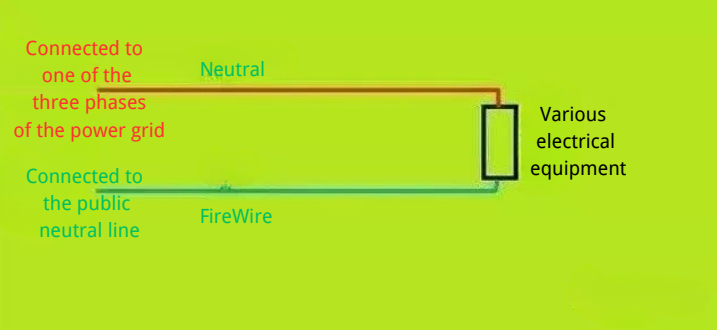
Under normal circumstances, the idea that something is not electrified is somewhat misleading. Not electrifying someone doesn't necessarily mean there's no electricity. For example, a dry cell battery doesn't electrify someone, but it does have electricity. When people say 'no electricity,' they simply mean the voltage is very low, not that there's no electricity at all.
While the neutral wire won't electrify someone, in some cases, it can be just like the live wire and carry a very high voltage, such as in the following situation:
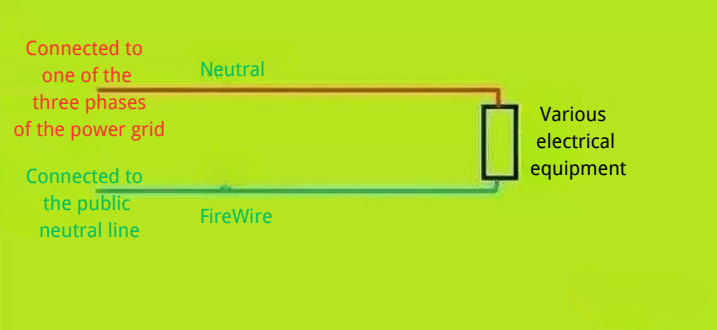
Neutral wire disconnect
When the neutral wire is disconnected, the part that was once the neutral wire may now carry the same voltage as the live wire (e.g., 220V). If the neutral wire is disconnected and the switch on an electrical device is closed, the neutral wire will now carry 220V. Although electrical devices like light bulbs may not be lit at this time, it is still dangerous. Touching the part that was once the neutral wire could cause an accident.
Electrical devices only work when there is current flowing; they will not function if there is only voltage. Voltage doesn't require a complete circuit to generate, while current does. If the neutral wire is disconnected, the current stops.
So, if you encounter an electrical device that isn't working, don't touch it directly to repair it. Instead, determine whether the problem is with the device or the neutral wire.
The diagnosis is simple: check whether other electrical devices in your home are functioning properly. If all devices are not working, it's likely that there's either a power outage or a broken neutral or live wire. It would be fine if the live wire was broken, as people are very vigilant about it. However, if the neutral wire was broken, it would easily lead to misjudgment and cause an irreversible disaster.
How to prevent neutral wire from being live? Here are 8 major aspects to pay attention to!
1. Maintain three-phase load balance
Maintain a balanced three-phase load as much as possible. Regardless of the load on the main line or branch line, the imbalance should not exceed 20%. Otherwise, voltage and power losses will increase significantly.
2. Secure neutral wire connection
The neutral wire must be securely and reliably connected to the transformer's neutral point. If the neutral wire is aluminum, the connection must be particularly careful. If the wire diameter exceeds 16 mm², the aluminum wire should be crimped through an aluminum terminal block to ensure good neutral conductivity. Then, connect it to the neutral terminal block. Avoid crimping the aluminum wire around the neutral grounding bolt by wrapping it around the wire. This is because the surface of aluminum wire is easily oxidized or corroded, making it non-conductive.
3. Proper fuse installation
It is strictly forbidden to install a fuse at the neutral point of a three-phase, four-wire circuit to prevent the fuse from blowing due to various reasons, resulting in a 'neutral break.' Otherwise, single-phase appliances connected to the circuit may burn out due to excessive voltage, or become inoperable due to insufficient voltage. Therefore, switches and fuses should not be installed on the neutral line. However, a fuse must be installed on the neutral line of a single-phase power supply line. This is because the neutral line only serves a working purpose. Double-pole knife switches and fuses should be installed on both the phase and neutral lines. If the phase and neutral lines are misconnected during external line maintenance, the fuses will still provide protection. If a fuse is installed only on the phase line, the phase line will become the neutral line. In the event of a ground fault, the short-circuit current will not flow through the fuse, and the fault will persist, posing a threat to the system.
4. Neutral point grounding resistance
The neutral point grounding resistance must meet the requirements. During the annual electrical inspections, check and measure the connection resistance of all transformers (no more than 4 for transformers 100 kV and above, no more than 10 for transformers below 100 kV). At the same time, strengthen neutral line maintenance and servicing, regularly inspect and tighten the transformer neutral point bolts to prevent poor neutral contact.
5. Neutral wire specifications
Ensure that the neutral wire has sufficient cross-sectional area and strength. Generally, it should be no less than 50% of the phase wire cross-sectional area, and usually about 60% of the phase wire cross-sectional area. It should also meet mechanical strength requirements. Avoid joints on the neutral wire. If this is unavoidable, carefully follow the process requirements to ensure a secure connection.
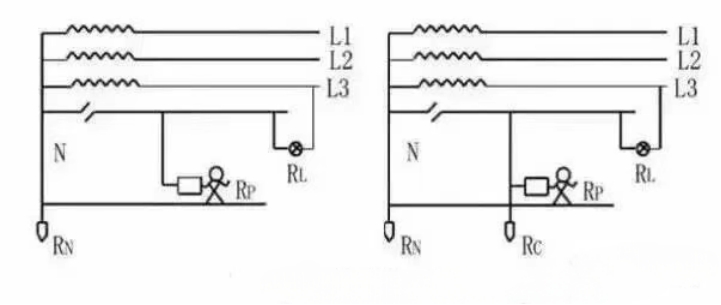
6. Repeated grounding
When the neutral line enters the switch box, a repeated grounding is set. The repeated grounding resistance shall not be less than 10. As shown in the figure, in the absence of repeated grounding, the voltage of the neutral line behind the disconnection point and all the neutral-connected devices on it to the ground is: UE=RP/(RN+RP+RL)*U
In the formula, RN, RP, and RL are the working resistance, human body resistance, and load resistance, respectively; U is the phase voltage. For example, if U = 220V, RN = 4V, RP = 1500V, and RL = 484V (rated power 400W), the above formula yields UE = 166V. This presents a significant risk of electric shock. Furthermore, the greater the unbalanced load, the higher the fault voltage, and therefore the greater the risk of electric shock.
In the presence of a double grounding, the voltage to ground of the neutral conductor and all connected neutral devices immediately after the disconnection point is: UE = RC / (RN + RC + RL) * U
Where RC is the double grounding resistance, if RC = 10 and other conditions remain unchanged, the fault voltage is UE = 4.4V. This significantly reduces the fault voltage, significantly reducing or eliminating the risk of electric shock.
7. Correct wiring connection
Ensure the phase and neutral wires are connected correctly to avoid misconnection. If the phase and neutral wires are misconnected, the voltage on single-phase equipment can rise to 380V, causing damage. Some users in residential areas have been known to steal electricity by running phase wires for lighting from the hallways into their homes.
If the main neutral wire on a floor burns out, the phase voltage will become line voltage if the power source is not the same phase. This voltage will be applied directly to the load, causing damage. For three-phase, four-wire loads, especially motors, misconnecting the phase and neutral wires can also reduce motor torque due to phase loss, potentially leading to damage.
8. Minimize connections
Minimize the number of line terminal connections and connectors on the neutral line, and minimize the number of switches and contacts connected in series to prevent the increased risk of neutral failure due to poor contact.
Summary
In short, in a three-phase, four-wire system, a live neutral line poses a significant hazard and can often lead to personal injury and equipment accidents. This is especially true in residential areas, where transformer outgoing lines are all three-phase, four-wire, and load phase deviation is significant.
To prevent accidents, regularly inspect the neutral line and double-ground each household entrance. Additionally, use a leakage protection circuit breaker (MCB) that automatically trips in the event of a neutral line failure, minimizing equipment and personal safety and ensuring normal and stable power supply.
Author:
Guangzhou Aputon Electrical Co.,Ltd.









CONTACT
Office-ADD: Second floor, Jiutan Village, Xiuquan Street, Huadu District, Guangzhou, Guangdong, China
Factory-ADD: Fenjiangbei Road No.91, Chancheng, Foshan, Guangdong, China
(formerly State-owned Foshan Transformer Factory)
Phone: +86-15876591363
00 1 (323) 841-2808
E-mail: Tony@aputon-transformer.com
Lily@aputon-transformer.com





 WhatsApp
 E-mail